Dadi's Slow Road
The wedding was at seven, in the town where Papa grew up. The whole family was in the car by three — pressed clothes on hangers, gift envelope in Ma’s purse, sweets box on Kabir’s lap with strict instructions.
Then it rained the way it rains only when you have somewhere to be.
By four-thirty the highway had stopped being a road and become a parking lot in a lake. The phone map showed one long red line and, where the underpass had flooded, a proud blue symbol of a boat.
“There’s no way around,” said Papa, zooming in and out, as if a new road might appear at a different zoom. “The map shows nothing.”
From the back seat, from somewhere inside her shawl, Dadi said, “The map is young. There’s the old road.”
Kabir’s Dadi did not use the phone map. Kabir had once tried to teach her and she had listened politely, the way you listen to a child explaining something you invented.
“What old road?” said Papa.
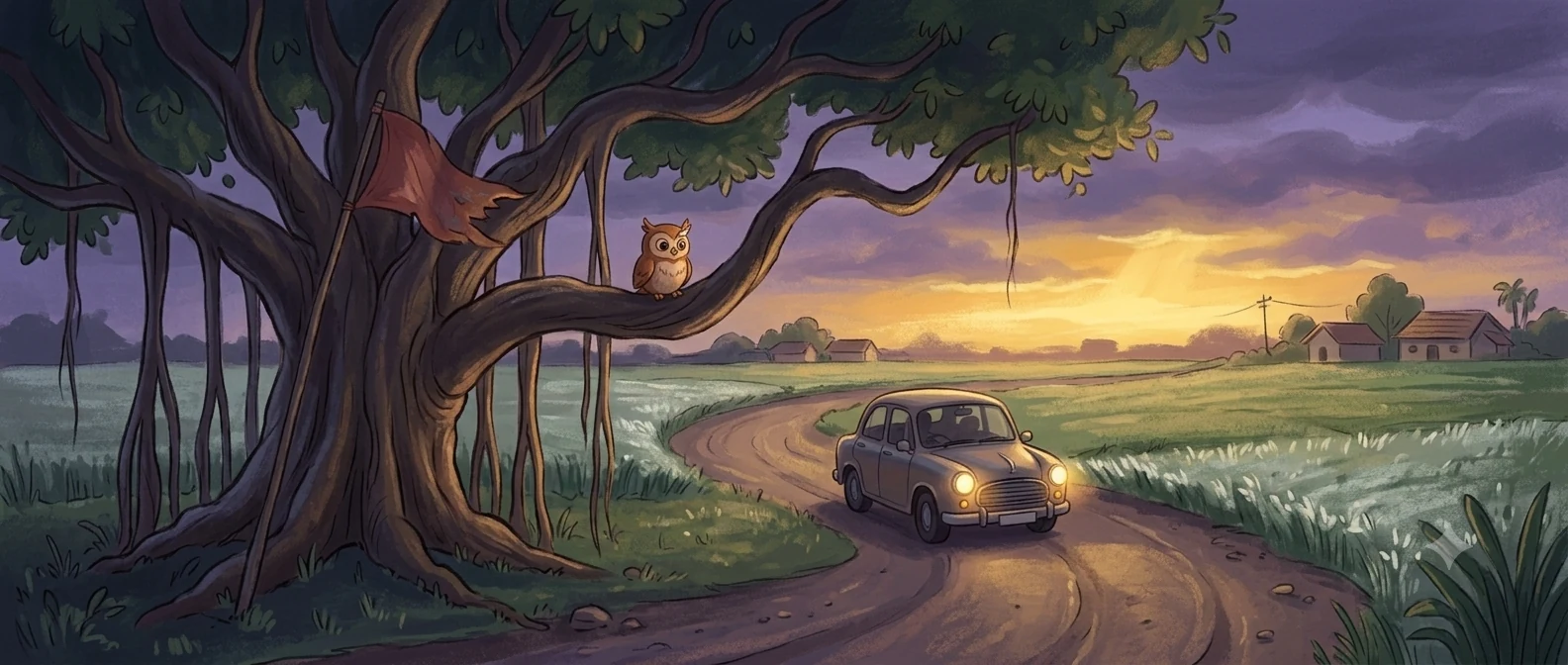
“The one we took before they built your highway. Turn around. Go back past the brick kilns. At the banyan with the red flag, go left.”
“Ma, there’s no left there—”
“There has been a left there,” said Dadi, “since before you were born. The map doesn’t know it because nobody asked the map to remember. Turn around, beta. The wedding is at seven.”
Papa looked at the red line. Papa looked at the rain. Papa turned around.
The banyan with the red flag was exactly where she said — enormous, older than the highway, older than everything, a faded red flag still tied in its branches from some long-ago festival. And beside it, half-hidden, a left turn: a narrow lane, brown and wet, running off between the fields.
“Now straight until the well with three steps,” said Dadi, sitting up, her window down despite the drizzle. “My cousin fell into it once, in 1962. Beautiful boy, no sense at all.”
Kabir stopped guarding the sweets and started listening.
They drove between fields silver with rain. The well with three steps appeared and was passed (“Right here — slowly, this bend has opinions”). Every turn came with a piece of story attached. The mango orchard where Dadi and her sisters were once chased by exactly one goose. The school with the blue gate where she had stood first in class, twice, “in mathematics, tell your father.” The stretch where you could see the temple hill early, if the sky allowed. And the sky, just then, allowed — breaking open gold at the horizon, like it too remembered the way.
“How do you know all this without a map?” Kabir asked.
“I am the map,” said Dadi. “Roads used to go through people. Now they go around them.” She said it without complaint, the way she reported the weather. “This is the through road.”
They reached the wedding at six-forty. Half the guests were still stuck on the highway; the groom’s own uncle arrived at nine and had to be given his dinner separately. All evening, relatives kept asking Papa how on earth they’d made it. Papa kept pointing across the hall at Dadi, who accepted each astonished visitor with the calm of a woman who had merely gone home the normal way.
On the drive back the next morning — highway open, map dutifully green — Kabir watched the old road slide past unmarked on the screen, invisible again.
“Dadi,” he said, “the banyan, the well, the goose orchard. Can you teach me the whole road? Every turn?”
Dadi looked at him for a moment. Then she settled her shawl the way she did before her longest stories.
“We’ll need paper,” she said, with enormous satisfaction. “It’s a long map, and it has people in it.”
Talk About It
- Why did Kabir think Dadi's directions wouldn't work at first?
- Dadi's map wasn't on paper or on a phone. Where was it?
- What's something an older person in your family knows that you'd like to learn before it's only theirs?
Did this story land tonight?
One tap helps us write better ones. No login, nothing shared publicly.
Thank you — this genuinely helps. 🌙