Where Did the Sparrows Go?
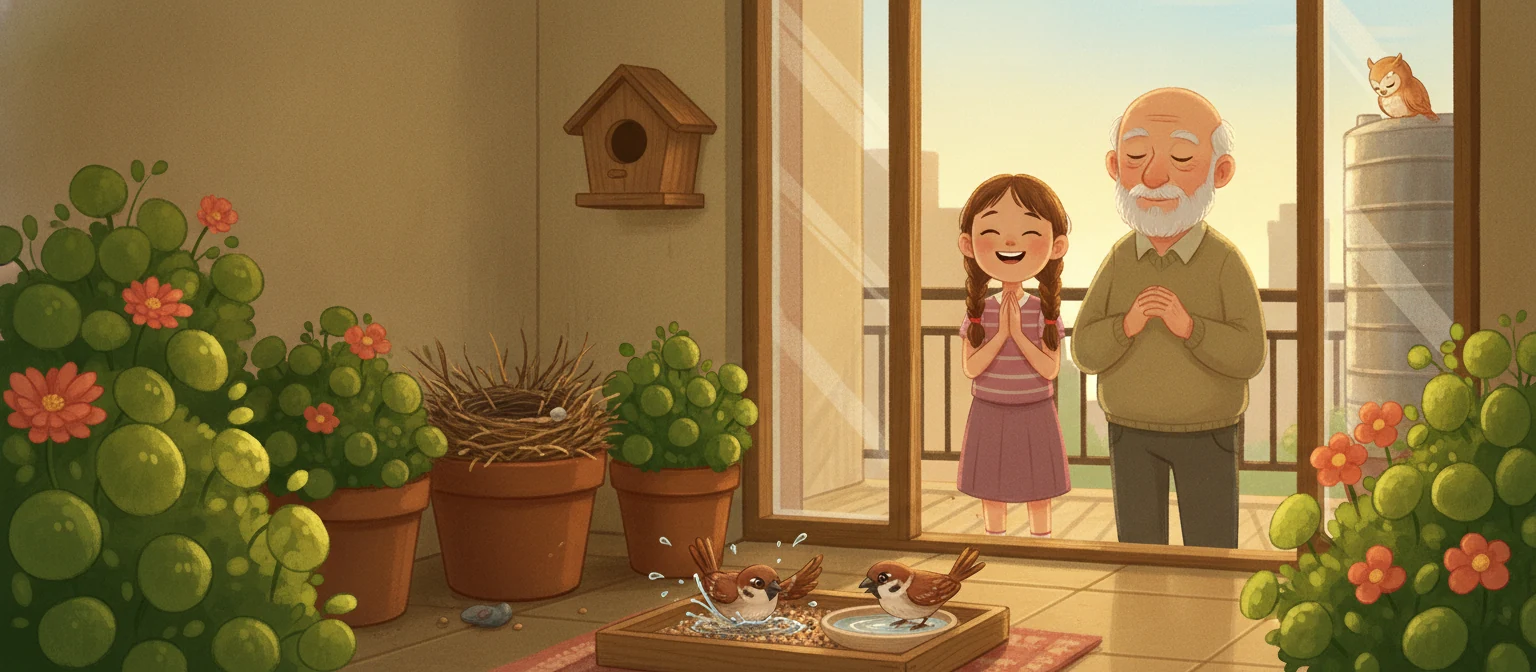
It started with a sound Dadu made at the morning tea — a small tch, aimed at the balcony.
“What?” said Riya.
“Listen,” said Dadu.
Riya listened. Traffic, a pressure cooker somewhere, a crow with opinions. “To what?”
“Exactly,” said Dadu. “When I was your age — right here, this very lane — you couldn’t drink your tea without a hundred sparrows arguing about it. Every hedge was a parliament. Every windowsill had its gang. Little brown fellows, cheeky as anything, they’d take the poha off your plate if you blinked slowly.” He looked out at the quiet balcony rail. “Now. One crow. Where did the sparrows go?”
Riya was seven-going-on-eight and had honestly never thought about sparrows in her life. That was the strange part, she decided — you’d notice if the sun went missing. But something small that leaves slowly, a little less every year… nobody notices the day the last one doesn’t come.
They investigated, she and Dadu, in the way of a seven-year-old and a seventy-year-old, which is thoroughly. And the answer, when they assembled it, wasn’t one big villain. It was lots of small subtractions. The old houses’ roofs had ledges and gaps and nooks where sparrows nested; the new flats were smooth as biscuits, nowhere to tuck a nest. The grain that used to spill from cloth shopping bags and roadside weighing scales came sealed in plastic now. The hedges — the messy, twiggy, insect-filled hedges where sparrows held their parliaments — had become clean walls and parking. Even the puddles were paved. Nobody had chased the sparrows away.
Everyone had just tidied up every small thing they needed, one convenience at a time.
“So they starved?” Riya asked, horrified.
“They moved,” said Dadu. “Wherever the small things still exist. The question is whether anyone invites them back.”
That became the summer’s project, and it cost almost nothing — that was the part Riya would remember whenever grown-ups said saving nature was expensive. A shallow mud saucer of water on the balcony ledge, refilled each morning (she already knew this technology from her school friend Anya’s famous bowl). A handful of bajra scattered in a foil tray — Dadu bought it by the kilo from the same shop that had once spilled it free. One pot in the corner deliberately left messy: twigs, dry grass, no tidying allowed, to Riya’s mother’s visible suffering. And on the wall, tucked under the water-tank’s shade, sat a small wooden nest-box. Riya and Dadu had built it from a fruit crate, in one gloriously unsupervised afternoon of sawing and hammering and one bandaged thumb.
Then — nothing. For eleven days, nothing. Bajra untouched, water unrippled, nest-box vacant. The balcony sat there like a shop with no customers, and Riya sagged.
“Patience,” said Dadu. “An invitation takes time to travel by wing. They have to find it, then trust it. Sparrows read a balcony the way your Amma reads a new shop — from a distance, twice, before entering.”
On the twelfth morning, there was an argument on the balcony rail.
A small, scratchy, chirping argument — two brown birds disputing possession of the bajra tray as if it had always been theirs. Riya froze mid-poha. Dadu lowered his newspaper with the slow-motion care of a man defusing something.
“Parliament,” he whispered, “is back in session.”
They came every morning after that. Four sparrows by August. Then a scandalous water-saucer bath that Riya rated better than television. And in September — the crowning event — dry grass began disappearing into the nest-box, one beakful at a time. The messy pot was being harvested. Riya’s mother was informed that the mess was now officially infrastructure.
The morning the chicks hatched, you could hear them from the breakfast table: tiny, insistent, brand-new voices over the traffic and the pressure cooker, exactly where the quiet used to be.
Dadu raised his teacup to the balcony.
“That sound,” he said, “is what missing things sound like when somebody leaves the small doors open.”
Riya wrote the recipe on the last page of her holiday homework, where she figured the future could find it: Water. Grain. One messy pot. A box with a hole. Wait twelve days.
Serves: everybody.
Talk About It
- Riya had never noticed the sparrows until Dadu said they were missing. Why is it hard to notice something disappearing slowly?
- The sparrows needed such small things — a ledge, some grain, water, one messy hedge. Why had all those small things vanished?
- What's one 'sparrow-sized' thing our home could offer — a water bowl, some grain, a pot the birds could visit?
Did this story land tonight?
One tap helps us write better ones. No login, nothing shared publicly.
Thank you — this genuinely helps. 🌙