The Plant That Moved Cities
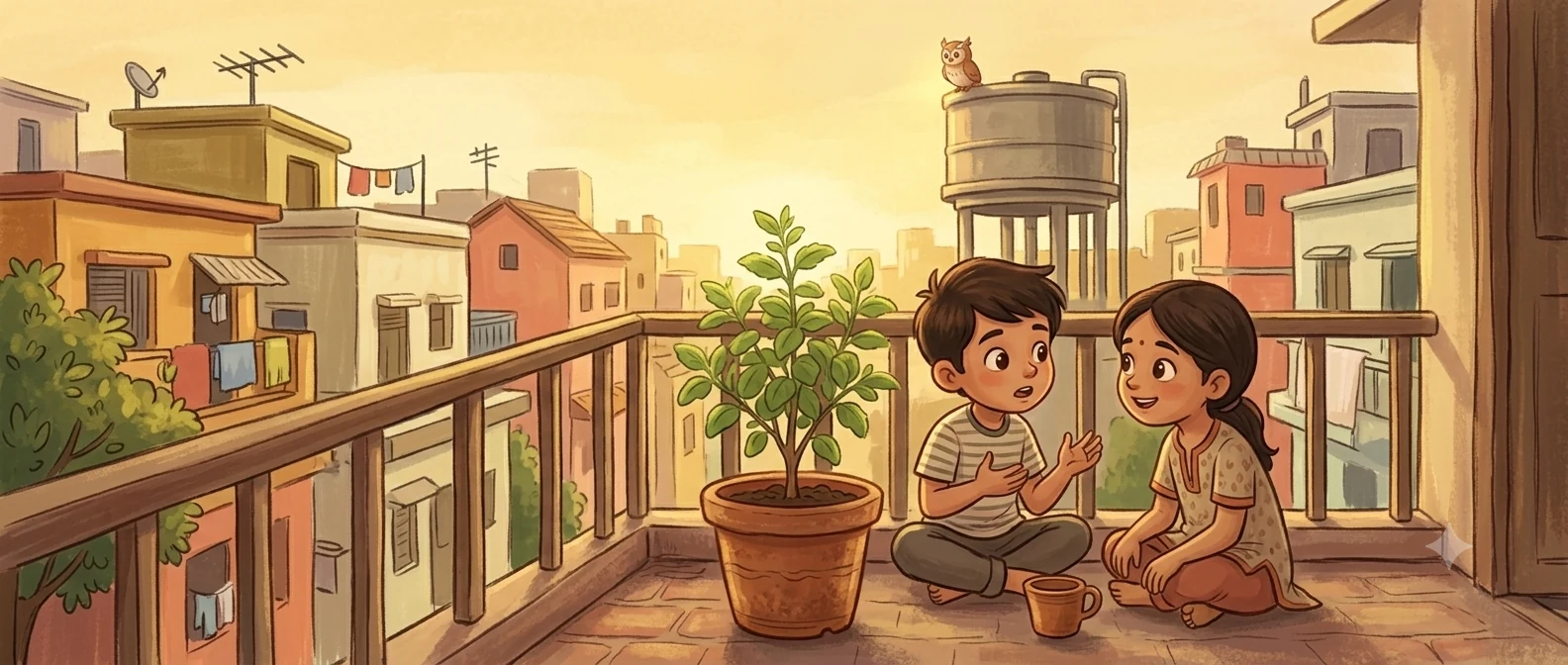
The lane knew Ishan and Ishan knew the lane.
He knew which gate had the dog that barked at bicycles but not at people. He knew the exact crack in the pavement that made cricket balls bounce sideways. He knew that his best friend Adil lived two floors down, seventeen stairs exactly, and that the neem tree outside their building was the finish line for every race that had ever been run.
Then Papa got the news about the new job, and the news came with a city attached: Bengaluru. Two days away by train. Everything about the move happened fast after that — cartons, tape, lists — and none of it asked Ishan’s opinion.
The evening before they left, Nani called him to her balcony garden. She had cut a small stem from her old tulsi plant — the one she’d grown, she liked to remind everyone, from a cutting her mother had given her. She wrapped the stem’s end in wet cloth and put it in a plastic bag.
“Carry this in your hand,” she said. “Not in the luggage. In your hand.”
“It’s a stick, Nani.”
“It’s a start,” said Nani. “Sticks are how tulsi travels. It can’t bring its old roots along — nobody can. It grows new ones.”
Ishan carried the stick on the train mostly because Nani was watching when they left.
The new flat was bigger than the old one. Everyone kept saying that, as if bigger was the thing that mattered. The balcony looked out at rooftops he didn’t know, and the lane below had a dog he didn’t know, and no neem tree, and no Adil — no seventeen stairs to anywhere.
“I hate it,” Ishan said, on the first night, to nobody.
But the tulsi cutting needed planting — wet cloth doesn’t last. So the next morning he and Ma found a clay pot at the corner shop. Ishan pressed the stem into the new soil, and drowned it, probably, with water.
Then, because he had nothing else to do, he checked it every day.
For a week it did nothing. It didn’t wilt, it didn’t grow; it just stood in the strange new soil, thinking things over. Ishan knew exactly how it felt.
On the eighth day there was a new leaf. Small, bright, undeniable.
“Ha!” said Ishan, out loud, alone on the balcony — and a voice from the next balcony said, “Ha, what?”
A girl about his age was leaning over the rail, watching him talk to a plant. This was embarrassing for around four seconds, which is how long it took her to add: “Is that tulsi? My Ajji has a whole jungle of it. She’ll want to see yours. She talks to hers also, so you’re normal.”
Her name was Tara. Her Ajji’s balcony jungle was genuinely worth seeing. And it turned out Tara also played cricket, in the ground behind the building. There — she pointed — a gulmohar tree served as the finish line for every race that had ever been run.
That night Ishan video-called Nani and held the pot up to the camera.
“New leaf,” he reported. “Two, actually.”
“Of course,” said Nani, entirely unsurprised. “That’s the thing I forgot to tell you about tulsi.” She leaned closer to the screen, the way she did for secrets. “The old roots stay in the old ground, beta. But whatever made it tulsi — that travels.”
Ishan looked past the phone at the new leaves, and out at the rooftops, which were still strange but slightly less strange than Tuesday.
New ones growing. Both of them.
Talk About It
- Why do you think Ishan was angry at the new flat, even though it was bigger?
- What did the tulsi cutting need to grow in a new place? What did Ishan need?
- If you had to carry one small thing from your home to a new one, what would it be?
Did this story land tonight?
One tap helps us write better ones. No login, nothing shared publicly.
Thank you — this genuinely helps. 🌙