The Only Bat
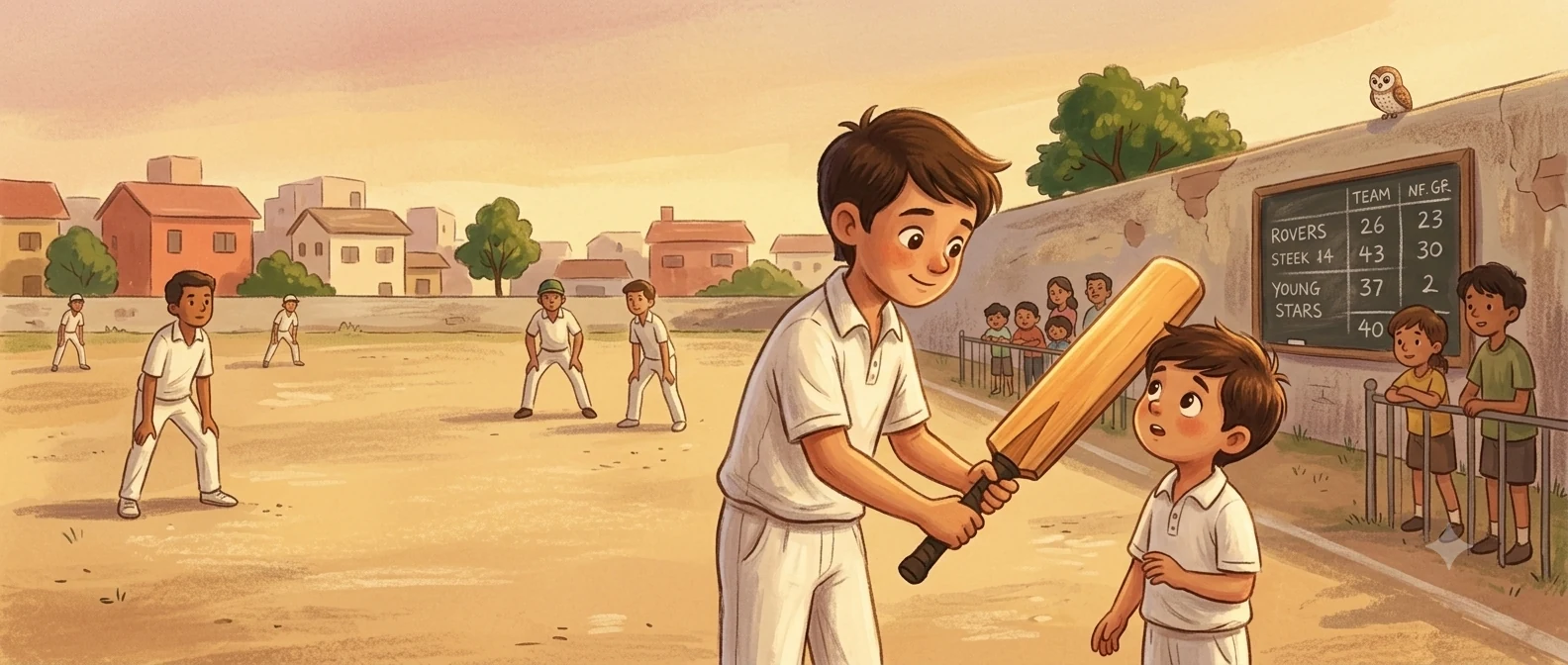
For his ninth birthday, Arun got the thing he had asked for through two Diwalis and one report card: a real bat. Not a plank, not a plastic toy — a proper willow bat with a rubber grip and a smell of fresh oil, the kind of bat that made a tock instead of a thap.
In the whole colony, among all eleven cricket-playing kids, it was the only real bat.
For the first week, Arun brought it down every evening and everyone crowded around. And every evening, the same question, eleven times: “Can I try one shot? One only?”
And here the trouble began. Because the bat was his. He had waited two years. What if Ketan — who swung wild — cracked it? What if it got scuffed on the concrete side? The second week, Arun made a decision that felt very sensible at the time: the bat would come down, but only Arun would bat with it. Everyone else could keep using the old plank.
The third week, the game changed around him, quietly, the way water changes around a stone.
The others started their match earlier, with the plank, on the far side of the ground. Nobody crowded around anymore. Arun stood at the near side with his beautiful willow bat and its beautiful tock, batting against his little cousin’s gentle bowling. Six runs a ball. King of a country with two people in it. He could hear the real match across the ground — the arguing, the appealing, the run-out drama, all the noise of actual cricket — happening entirely without him.
By Friday he wasn’t even bringing the bat down. It stood in the corner of his room, oiled and perfect and safe. And Arun sat on the boundary wall watching the plank match like a spectator at his own game.
His grandmother found him there, because grandmothers patrol boundary walls.
“Beautiful bat,” she said. “Where is it?”
“Upstairs. Safe.”
“Ah. Safe.” She said the word like she was turning it over, looking underneath it. “You know, my father had a radio once — first one in our lane. Beautiful thing. Two choices with a thing like that. Lock it in a cupboard where nothing can happen to it — and nothing ever happens to it, no songs, no cricket scores, no neighbours leaning in the window on match days. Or put it in the window and let the whole lane listen — scratches, fingerprints and all.” She nudged him. “Which one do you think we did? Ask me how I know the 1960 final.”
Arun looked across at the plank match. “But if Ketan cracks it—”
“Then you’ll own a cracked bat with a hundred matches in it, instead of a perfect bat with none. Anyway — who said sharing means no rules? A thing can be yours and everyone’s. That’s not magic, it’s management. My father had rules for the radio too. Volume knob was his. Nobody touched the volume knob.”
Arun thought about it for one more full day, which is the honest speed of these decisions.
Saturday evening, he came down with the bat and stood at the edge of the plank match until the game paused.
“New rules,” he announced, in his best volume-knob voice. “The bat plays. Everyone bats with it, in the batting order, no arguing. But — grip gets taught by me first, no swinging it at stones, no leaving it on the ground, and it goes home with me every night.”
Eleven kids looked at the willow bat. “Done,” said everyone instantly, because kids will agree to any constitution that contains real cricket.
And the colony game got its tock.
It changed things in ways Arun hadn’t predicted. Batting felt different when the whole match watched the bat come to them down the order. The youngest kid’s first proper cover drive off the real bat got cheered like a century — and it was Arun who’d taught him the grip. The bat did get scuffed. It got a fine crack up the shoulder in August, from Ketan, exactly as foreseen. Six kids taped it over the same evening, working like surgeons. The tock went slightly husky, and honestly, nobody could tell the difference from the boundary.
By winter the bat looked like a war hero and was known ground-wide simply as The Bat. If you’d asked any kid in the colony whose it was, you’d have gotten the answer Arun himself now gave — with the grip-teaching rights and the going-home-nightly rule intact behind it:
“Mine,” he’d say. “It plays for everyone.”
His grandmother said that was also, more or less, how radios and countries were supposed to work — but that, she said, was a conversation for a later birthday.
Talk About It
- With the bat locked safely at home, Arun lost something. What exactly did he lose?
- Arun made rules when he shared the bat. Does making rules make sharing smaller — or does it make it work?
- Is there a difference between something being yours and something being only yours?
Did this story land tonight?
One tap helps us write better ones. No login, nothing shared publicly.
Thank you — this genuinely helps. 🌙