Half My Room
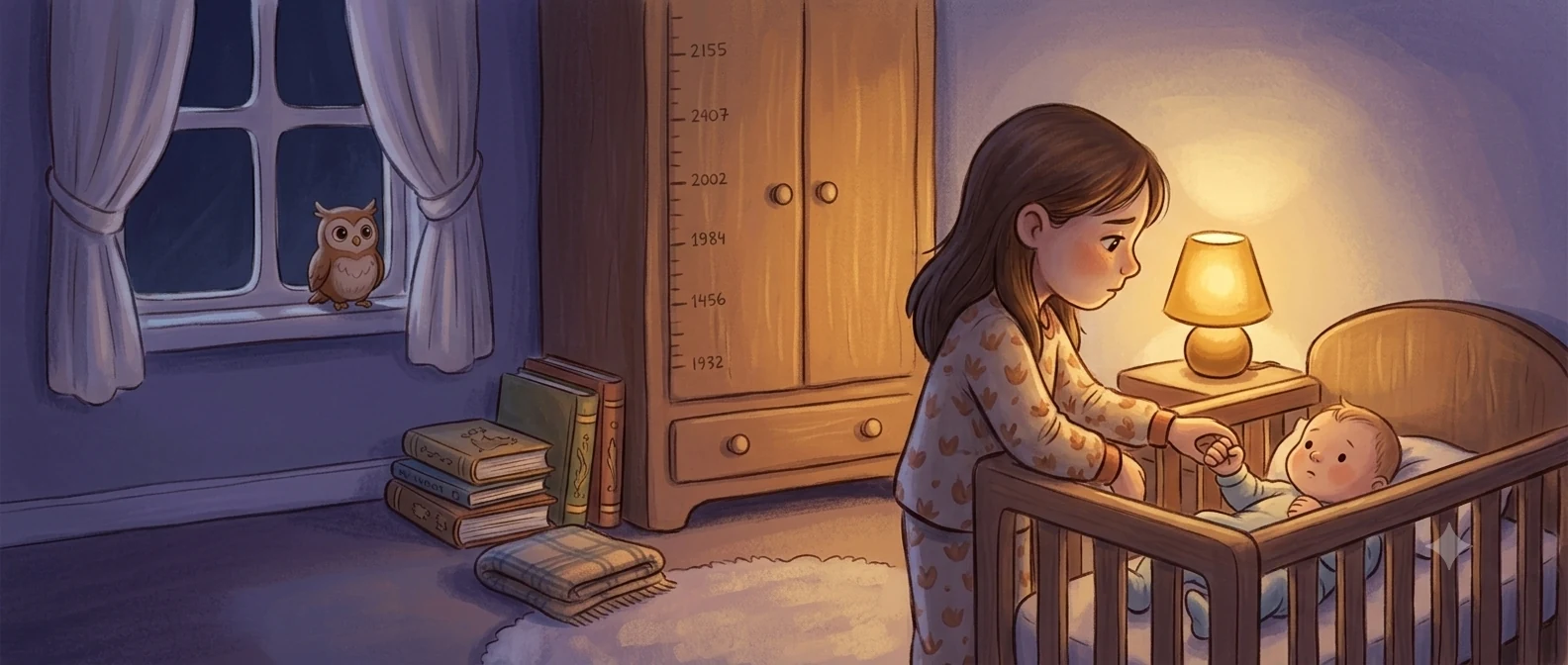
The baby was born in March. Before the month was out he had taken half of Myra’s room.
Her posters. Her desk by the window. The wall with eleven years of pencil height-marks. Then, in one weekend, the guest cupboard walked out. A crib walked in. A rented changing table was pushed up against her desk, so close that her chair scraped it every time she sat down.
“Just for a couple of years,” said Ma.
Myra was eleven, and everyone kept telling her what eleven meant.
It meant you’re the big sister now, said the way grown-ups say something they expect you to be pleased about. It meant you understand, na? Somehow that always came right before her hairbrush, her charger, or her good pencil case went missing into the nursery. The baby screamed at night, and the house was tired in the morning, all the way down to her. Nani came in the front door and went straight to the crib, handbag still on her shoulder. The neighbours brought gift boxes with his name on the ribbon. Myra ate her toast standing up at the kitchen counter most mornings now, because the table had a diaper bag and a burp cloth on it.
She told no one this part. Some nights, lying in bed with the wall between them still warm with the sound of him crying, she thought: I wish they had never brought you home.
Other afternoons, he slept with both fists thrown up beside his head, one sock kicked off. She would stand by the crib’s wooden bars for ten whole minutes, just watching him breathe.
Myra wanting him gone. Myra standing guard by his crib, ready to fight anyone who came through the door. Both, in the same girl. In the same week. Sometimes in the same hour.
The colic started in June. The doctor called it colic. Her family called it the sirens. It was past three in the morning, and he had been going for an hour straight. Through the wall Myra heard her parents cracking. Ma’s voice had gone thin. Papa was walking the hall in his chappals, and the chappals were squeaking on every third step, the same third step, over and over.
“You went at eleven,” Ma was saying.
“I went at twelve-forty. Check your phone.”
Myra got up. She stood in the doorway between her old half of the room and the new one and looked at them. Ma sat on the edge of the bed with the baby howling on her shoulder. Papa stood frozen in the middle of the hallway with one chappal still squeaking under his weight.
“Give him,” said Myra.
Nobody moved.
“Give him to me and go lie down for twenty minutes. I know how to hold him. You’ve corrected me forty times. My elbow does the thing by itself now.”
Ma looked at Papa. Papa looked at the baby. Then the baby came across into Myra’s arms, mid-scream, hot and furious as a just-boiled kettle, his fists windmilling against her pyjama sleeve. She walked the length of the room, past her own desk and past the crib, bouncing him, swaying him. She had watched it done a hundred times in three months. Nobody had ever once handed her the job.
The night lamp was still on, low and gold on the crib rail, and nobody was awake to hear her, so she talked to him.
“That cupboard you evicted had my red kite in it. Still does, somewhere in the store room. The wall behind you is where I’ve been measured since before anyone had thought of you.” Bounce. Sway. “You’ve taken the room, and half the year, and both parents, and you can’t even see yet. You’re the worst roommate in this building.” Bounce. “And apparently I’m the one who stays up for you now. Nobody asked either of us.”
The baby, mid-wail, stopped.
Not slowly. All at once, the way a fan stops when the switch goes. He gripped her one finger with his whole fist, tighter than something that small should have been able to grip. He looked up at her for a long moment. Then he made a small sound, low in his throat — hm — and shut his eyes.
He was asleep in four minutes.
Her parents found them at dawn. Myra was cross-legged on the floor by the crib, asleep against the wall of her own height-marks, her finger still caught in his fist. Papa lifted a folded quilt off the end of her bed and put it over her shoulders without waking her. Ma stood in the doorway for a while, looking at both of them, and then went down to put the kettle on.
Nobody made a fuss about it at breakfast, over the toast and the tea. But that evening, when the baby started up again after dinner, Papa held him out across the kitchen without a word. She took him without a word back. The 3 a.m. hm, Papa started calling it, whenever it happened again. It was hers now. Nobody else’s arms did it.
The bad feeling did not go away. In August she shouted at Ma about the changing table for a solid hour and meant every word of it. The crib stayed in her room for two years, not “a couple,” exactly as she had told nobody it would.
But on the wall with her eleven years of pencil height-marks, there is a new mark now. Low down. In her own handwriting, done with the same stub of pencil kept on the windowsill for the job. Made the week he learned to stand by pulling himself up on her desk drawer.
Him. Month 11. Roommate.
Talk About It
- Myra loved the baby and resented him in the same week — sometimes the same hour. Do you think one of those feelings was the 'real' one, or were both?
- 'You're the big sister now' felt like a demotion to Myra. What did the 3 a.m. night change for her?
- What's something only the oldest one in a family can do — not chores: actually do?
Did this story land tonight?
One tap helps us write better ones. No login, nothing shared publicly.
Thank you — this genuinely helps. 🌙