The Loudest Notification
The group was called 6B Official 😎 and it was basically an extra period of school. Except this one never ended.
Four hundred messages was an ordinary evening. Memes. Homework panic. Voice notes. Polls. A fight about the poll. The peace treaty. More memes about the fight. Naina wasn’t even one of the loud ones. She was mostly a reader — but a complete reader, scrolled to the bottom, always. Because the one time she’d skipped an evening, she had walked into school to find a whole war had been fought and finished overnight. She’d stood at the lockers like a tourist, needing the jokes explained.
That feeling — arriving in her own life a day late — was what the scrolling was for. Two hours some nights. Thumb moving on its own. Not enjoying it, exactly. Patrolling it.
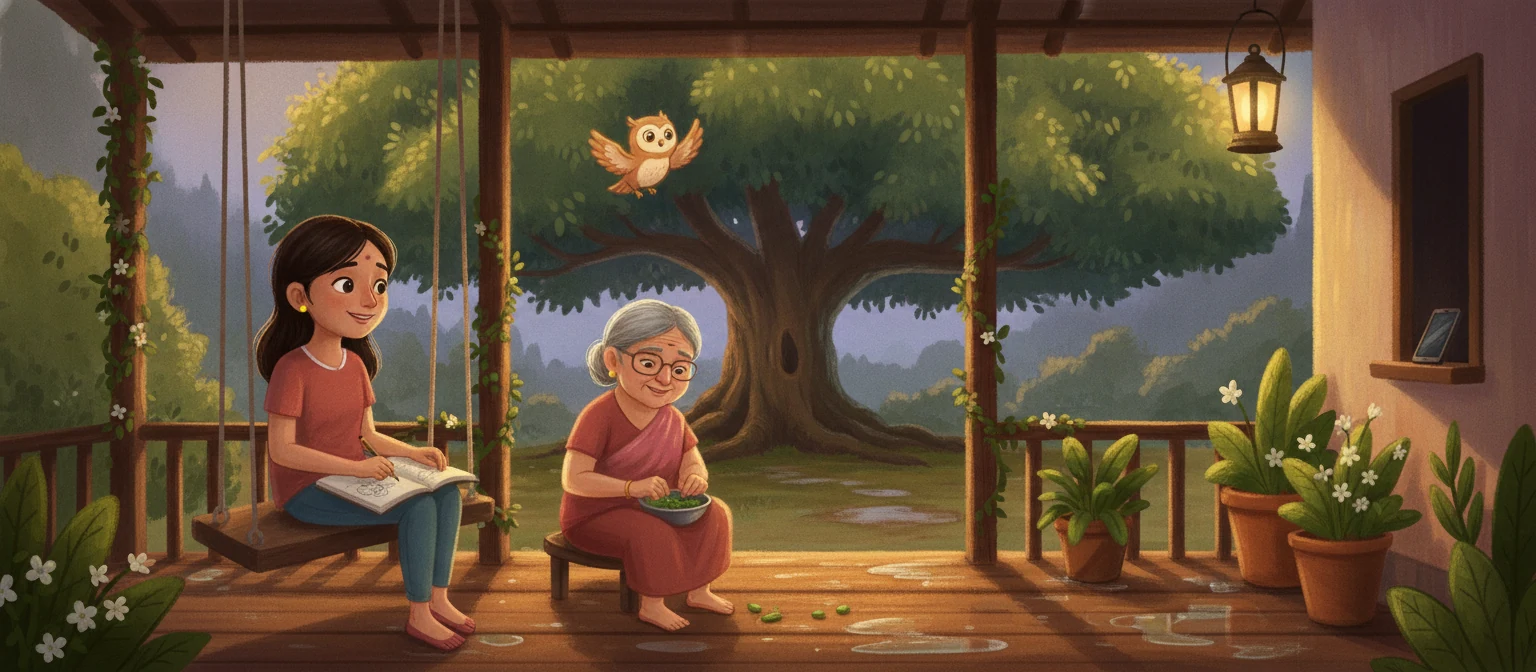
Then came the summer week at Ajji’s house in the Konkan. The network there lived in one corner of the front verandah. You stood on the second step and held the phone toward the coconut trees like an offering. Even then: one wavering bar, which loaded text and choked on videos.
Naina spent the first day twitchy. She reached for the phone dozens of times, found it useless, put it down. Each time came a little spike of something close to panic. Four hundred messages a day were piling up without her. The group was moving. She was falling behind — whatever that meant, wherever behind was.
On the second day, out of pure boredom — a boredom so deep she’d forgotten it existed — she picked up her old sketchbook. Her mother had packed it. Suspiciously well-prepared.
She drew the rain tree across the yard. Badly, then less badly. The thing about drawing a tree, it turned out, was that the tree held still and asked for nothing. No reply. No reaction. No keeping up. Time vanished around the sketchbook the way it vanished around the chat — but this time it left something behind on the page.
By the fourth day she had drawn the tree, the well, the ancient scooter, Ajji’s hands shelling peas (three attempts — hands are brutal), and the view from the second step of the verandah. The exact spot where the network lived, drawn from the outside. That struck her as privately hilarious.
And in the evenings, on the swing, Ajji talked. Real, long talk with no scroll in it — stories that took forty minutes and actually went somewhere. Naina found she could listen with her whole head. She had forgotten what her whole head felt like. For a long time her attention had been living the way she stood at the school lockers: half here, half patrolling somewhere else, braced for the next thing.
On the last evening, standing on the second step, she let the phone drink its one bar and watched 6B Official 😎 update. 2,247 unread.
She scrolled. And from this distance, she saw it all at once, the way you see your own handwriting in an old notebook. The fight (there had been one) — already resolved. The memes — already stale. The homework panic — expired. Two thousand messages, and everything that mattered in them could be caught up in forty minutes and summarised in four sentences. The chat wasn’t a place after all. It was a stream. And a stream doesn’t store anything. It just insists.
Her friends were real — that was the confusing part. Sana and Mishti and the others weren’t a trap. The chat wasn’t evil. Some of the memes were honestly excellent. The problem was narrower and sneakier: the group’s clock had become her clock. Four hundred small bells a day, each one ringing now, now, now — and she had stopped owning a single evening of her own life, without noticing when that happened.
She didn’t quit the group. This isn’t that story.
What she did, back home, was one small thing, entirely hers. The phone lived outside her room after eight o’clock. And 6B Official got a visiting hour — half past six, thumb through, react, reply, done. Not a punishment. A time slot. The chat became one show she watched, instead of the channel that ran all day. The first week, arriving at school, she braced for the tourist feeling.
It never really came. Wars that mattered got recapped in ninety seconds at the lockers, by people happy to recap them. The fear of missing out, it turned out, had mostly been fear of being seen missing out. And nobody was checking.
What she did with the reclaimed evenings is easy to guess. The sketchbook filled up, then a second one. She drew her own building, her street, the chai stall, Sana mid-laugh (four attempts — faces are worse than hands).
The group chat scrolled on, four hundred a day, perfectly fine without her patrol. A stream, doing stream things.
The sketchbooks stayed. That was the difference she could never quite explain to the group. So she drew it instead.
Talk About It
- Naina scrolled for two hours a day so she wouldn't 'miss anything.' Looking back from Ajji's house, what had she actually been missing?
- The group chat wasn't evil — her friends were genuinely in it. So what exactly was the problem? Where's the line?
- Naina ended up making one rule for herself, chosen by her. Why did that work better than rules made for her?
Did this story land tonight?
One tap helps us write better ones. No login, nothing shared publicly.
Thank you — this genuinely helps. 🌙